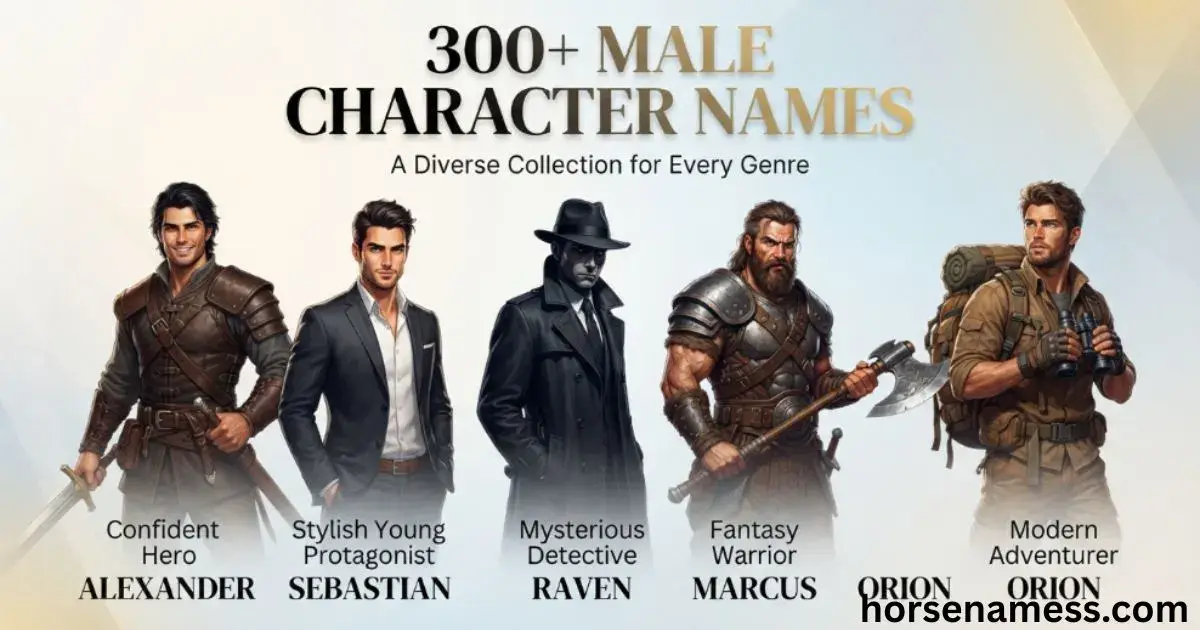
300+ Male Character Names Cool, Unique & Powerful Ideas
Male character names should match the character’s personality, setting, and story role. A classic name can suit a realistic protagonist, while a dark fantasy villain may need something sharper, and a royal character may benefit from a formal, historic sound. This guide offers cool, unique, traditional, inventive, fantasy, and powerful ideas.
After researching character-name lists and fiction-writing advice, one practical lesson stands out: a memorable name must be readable as well as distinctive. Writers often struggle with names that sound impressive in isolation but feel awkward in dialogue. The lists below help you explore names by genre, emotional tone, archetype, and worldbuilding purpose.
Quick character-name guide
| Character type | Names to explore |
| Classic protagonist | Edmund, Julian, Arthur, Elias |
| Cool antihero | Riven, Kael, Zane, Corvin |
| Fantasy warrior | Draven, Theron, Ulric, Vorn |
| Noble prince | Valerian, Aurelius, Hadrian, Caelorian |
| Dark villain | Malachar, Corvus, Venrath, Dusk |
| Magical character | Aether, Thalion, Solvan, Eldryn |
| Loyal companion | Finn, Milo, Caden, Bryn |
| Mysterious detective | Dorian, Silas, Vaughn, Lucian |
These are creative suggestions, not claims that a name guarantees a particular personality. Character behavior, dialogue, backstory, and relationships ultimately create the impression readers remember.
Classic Male Character Names
Classic male character names are useful when you want a character to feel familiar, established, or connected to history. Edmund, Arthur, Julian, Sebastian, Theodore, Marcus, Elias, Benedict, Vincent, and Alexander can work in contemporary fiction, historical stories, romance, or fantasy settings.
A familiar name does not have to feel boring. Its distinctiveness can come from the surname, setting, nickname, or contradiction between the name and the character’s behavior. A gentle character named Victor or a conflicted hero named Benedict can create an interesting contrast without relying on an unusual spelling.
Classic names for fictional characters
| Name | Suggested character impression |
| Edmund | Thoughtful noble or scholar |
| Arthur | Traditional leader or idealist |
| Julian | Refined, intelligent, or artistic |
| Sebastian | Elegant, ambitious, or mysterious |
| Theodore | Warm mentor or thoughtful protagonist |
| Marcus | Disciplined soldier or strategist |
| Elias | Reflective or spiritual character |
| Benedict | Formal, clever, or aristocratic |
| Vincent | Artistic, serious, or dramatic |
| Alexander | Leader, protector, or ambitious hero |
| Tobias | Kind, observant, or understated |
| Nathaniel | Literary, scholarly, or reserved |
Cool Male Character Names
Cool male character names often use concise sounds, unusual consonants, or modern associations. Kael, Riven, Zane, Dax, Jett, Onyx, Cipher, Rook, Thorn, Vex, Arrow, and Corvin can suit action characters, cyberpunk figures, rebellious protagonists, or mysterious antiheroes.
The danger with an overly “cool” name is that it may feel like a nickname rather than a complete identity. Pairing a striking first name with an ordinary surname can add realism. For example, Riven Cole, Jett Mercer, or Zane Holloway may feel more grounded than combining several dramatic words together.
Cool name ideas
- Kael Mercer
- Riven Cole
- Zane Holloway
- Dax Rowan
- Jett Calder
- Corvin Hale
- Onyx Vale
- Cipher Reed
- Rook Ashford
- Thorn Ellis
- Vex Marlowe
- Arrow Quinn
- Sable Cross
- Mael Carter
- Orin West
- Varis Lane
- Nox Sterling
- Krios Vance
- Drift Monroe
- Zeal Hart
A cool name should support the character’s actions instead of doing all the storytelling itself. A quiet character with a dramatic name can work especially well when the story gradually reveals why the name matters.
Unique Male Character Names
Unique male character names are useful when you want your protagonist or supporting character to stand apart from familiar naming patterns. Aevyn, Braelor, Cyndric, Drevan, Galadrin, Jorvak, Lyrion, Vaelorn, Rystan, Seldric, and Xaelion have an invented or fantasy-oriented sound.
Original names should still be easy enough for readers to remember. Before choosing one, say it aloud, write it in dialogue, and imagine a reader seeing it repeatedly across several chapters. If the spelling creates uncertainty, decide whether that ambiguity is intentional or simply a problem to fix.
Unique names with a believable sound
| Name | Tone |
| Aevyn | Soft fantasy or elven-inspired |
| Braelor | Noble warrior |
| Cyndric | Scholar or court official |
| Drevan | Dark adventurer |
| Galadrin | Ancient noble |
| Jorvak | Northern warrior |
| Lyrion | Mage or poet |
| Vaelorn | Royal fantasy |
| Rystan | Young protagonist |
| Seldric | Military or scholarly |
| Xaelion | Cosmic or high fantasy |
| Kelthon | Inventor or strategist |
| Corvyn | Mysterious rival |
| Durvan | Veteran fighter |
| Fyvian | Diplomat or court magician |
The examples above are creative constructions rather than verified traditional names. Avoid assigning a real-world cultural origin or established meaning to an invented name unless you have reliable evidence for that claim.
Warrior and Strong Male Character Names
Warrior and strong male character names often use firm consonants, short syllables, and associations with endurance, courage, or leadership. Draven, Holt, Flint, Talon, Axel, Vorn, Ward, Bron, Rex, Ulvar, and Mace can fit soldiers, champions, commanders, or characters shaped by survival.
Strength does not have to mean aggression. A strong character may be a protector, medic, strategist, or person who refuses to abandon others. Names such as Ward, Pax, Flint, and Holt can suggest different forms of strength depending on the character’s actions and background.
Strong names for warriors and commanders
| Name | Possible role |
| Draven | Relentless fighter or antihero |
| Holt | Ranger or practical survivor |
| Flint | Tough scout or engineer |
| Talon | Fast-moving warrior |
| Axel | Modern fighter or rebel |
| Vorn | Fantasy commander |
| Ward | Guardian or protector |
| Bron | Veteran soldier |
| Rex | Confident leader |
| Ulvar | Northern-inspired warrior |
| Mace | Direct and forceful fighter |
| Pax | Peacekeeper with a complicated past |
A powerful-sounding name becomes more convincing when the character’s behavior supports it. A physically intimidating warrior who is patient with children, for example, gains depth through contrast.
Royal and Noble Male Character Names
Royal and noble male character names often feature formal endings, historical associations, or longer syllable patterns. Alderon, Beaumont, Castellan, Davorian, Elarian, Valerian, Leonidas, Ptolemy, Othello, and Justinian can suit princes, kings, aristocrats, court officials, or heirs to an old dynasty.
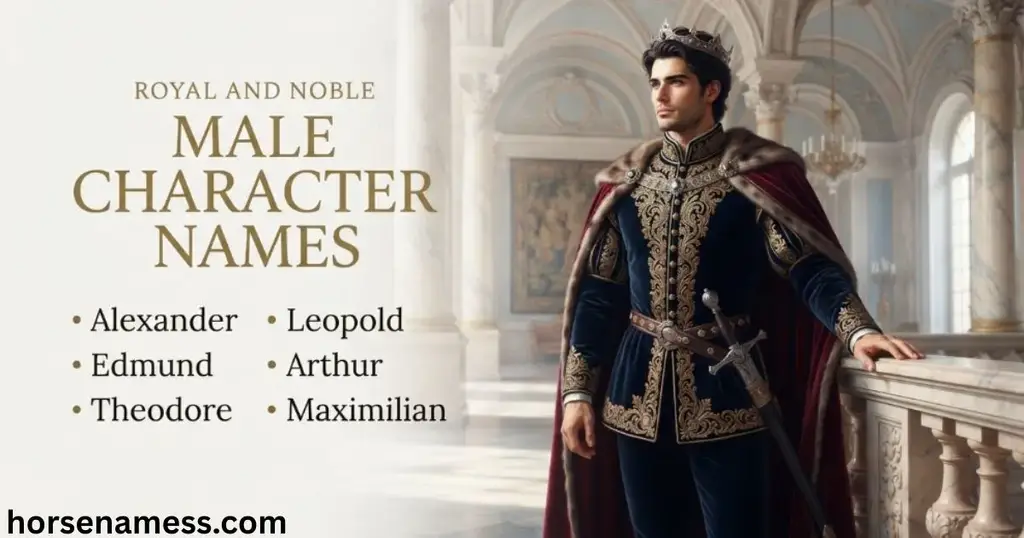
For believable worldbuilding, noble names should connect with the culture and language of the fictional kingdom. A single royal name may sound out of place if every other character uses a completely different naming system. Establish recurring roots, titles, and family naming traditions to make the setting feel coherent.
Royal and noble name ideas
- Alderon
- Beaumont
- Castellan
- Davorian
- Elarian
- Gavrilon
- Haderon
- Ivander
- Justinian
- Kalderon
- Leonidas
- Othello
- Ptolemy
- Quinterian
- Valerian
- Adrion
- Caelorian
- Theovian
- Marcellan
- Aurevian
Some names above are historical or established, while others are fictional constructions. Historical names such as Justinian, Ptolemy, and Leonidas carry real associations, so research their context before using them as if they originated in an invented culture.
Dark and Villainous Male Character Names
Dark and villainous male character names can create an atmosphere of danger, secrecy, corruption, or uncertainty. Malvern, Corvus, Venom, Blight, Malachar, Nihil, Scorn, Toxen, Wrath, Craven, Dusk, and Blackthorn may fit antagonists, cursed characters, assassins, or morally compromised figures.
A villain does not always need an obviously sinister name. A pleasant, ordinary name can make a character more unsettling when their actions contradict the impression created by the name. Consider whether you want the audience to recognize the threat immediately or discover it gradually.
Dark character name ideas
| Name | Suggested atmosphere |
| Malvern | Gothic or aristocratic |
| Corvus | Raven imagery and mystery |
| Malachar | Ancient or occult fantasy |
| Nihil | Philosophical darkness |
| Scorn | Direct hostility |
| Toxen | Poison or alchemy |
| Craven | Fear and moral weakness |
| Dusk | Quiet, shadowy presence |
| Blackthorn | Gothic family or bloodline |
| Venrath | Invented dark-fantasy sound |
| Hollow | Tragic or supernatural |
| Veyr | Minimalist and mysterious |
Avoid relying only on words such as Dark, Death, or Blood. A more subtle name paired with a threatening reputation can give the villain greater narrative range.
Mystical and Magical Male Character Names
Mystical and magical male character names often use flowing sounds, unusual combinations, and imagery connected to stars, dreams, ancient knowledge, or elemental power. Aether, Celindor, Faelon, Lumyn, Noveran, Thalion, Zenith, Astron, Eldryn, and Faerion can suit wizards, seers, magical scholars, or supernatural travelers.
The name should reflect the type of magic used in the story. A fire mage may have sharp, energetic sounds, while a healer or celestial scholar may benefit from softer vowels. Avoid assigning real cultural traditions to invented magical names unless the connection is deliberately researched and respectfully developed.
Mystical name ideas
- Aether
- Belorin
- Celindor
- Faelon
- Lumyn
- Noveran
- Orbyn
- Quinthar
- Solvan
- Thalion
- Umbral
- Xeryn
- Yvandor
- Zenith
- Astron
- Brymir
- Celestar
- Draevon
- Eldryn
- Faerion
A mystical name becomes more effective when the magic system gives it context. A character named Thalion may feel ordinary until readers learn that his family has guarded an ancient observatory for generations.
Main Character Names Male: Hero Archetypes
Main character names male protagonists carry should be memorable without distracting from the story. A hero may be a reluctant heir, fallen warrior, scholar, strategist, rebellious successor, or quiet guardian. Names such as Kaelan, Torvan, Elric, Darian, Soren, Caiden, Rylan, Stellan, and Theron can be adapted to different character arcs.
The most effective protagonist name often leaves room for change. A name that sounds noble at the beginning may become tragic after betrayal, while an ordinary name may gain significance through courage. Choose a name that can survive the character’s complete development rather than matching only the opening chapter.
Hero archetype name table
| Hero archetype | Name ideas |
| Reluctant hero | Kaelan, Darian |
| Fallen warrior | Torvan, Valdric |
| Scholarly knight | Elric, Theron |
| Quiet strategist | Soren, Stellan |
| Young king | Caiden, Rylan |
| Cursed champion | Malachai, Grael |
| Loyal guardian | Griffyn, Bryn |
| Wandering scholar | Theron, Oryn |
| Rebellious heir | Rylan, Caiden |
| Forest-born ranger | Erevan, Halvek |
A hero’s name can also evolve through nicknames. A formal birth name, a childhood nickname, and a title earned during the story may each reveal a different relationship or stage of identity.
Male Clan Names and Surnames for Fantasy Worldbuilding
Male clan names and surnames help communicate ancestry, profession, reputation, and geography. Examples such as Ironwall, Stormborn, Nightcrest, Emberstone, Frosthelm, Ravenstone, Shadowmantle, Stonebreaker, and Windblade can be used for families, guilds, noble houses, or legendary bloodlines.
A surname feels more believable when it has a reason to exist inside the world. Ironwall might refer to a defensive order, while Ravenstone could connect to a mountain settlement or a family emblem. Avoid assigning the same style of surname to every culture in your setting.
Fantasy surname combinations
| First name | Surname | Character direction |
| Kael | Ironwall | Veteran guardian |
| Dorian | Nightcrest | Noble with secrets |
| Aldric | Stormborn | Heir to a warrior line |
| Elric | Ravenstone | Scholar from an old family |
| Soren | Frosthelm | Northern strategist |
| Valen | Emberstone | Fire mage or blacksmith |
| Theron | Windblade | Traveling swordsman |
| Riven | Shadowmantle | Rogue or spy |
| Caelan | Dawnblade | Idealistic champion |
| Orin | Greystone | Practical ranger |
Surname-building principles
- Element + suffix: Storm + vale = Stormvale.
- Material + structure: Iron + wall = Ironwall.
- Nature + location: Raven + stone = Ravenstone.
- Action + object: Tide + breaker = Tidebreaker.
- Symbol + inheritance: Wolf + crown = Wolfcrown.
These combinations are fictional naming formulas, not evidence of real historical surname origins. Use them to establish an internal naming system for your fictional world.
Traditional
Traditional male names can create realistic characters in contemporary fiction, historical stories, family dramas, and grounded role-playing games. Examples include Benjamin, Charles, Edward, Henry, James, Joseph, Samuel, Thomas, William, George, Felix, and Oliver.
A traditional name can also help a fictional setting feel familiar to readers. However, the appropriate choice depends on the story’s location and time period. A name common in modern America may feel inaccurate in an ancient setting unless the story intentionally uses an alternate-history or contemporary framework.
Traditional male character names
- Alan
- Albert
- Austin
- Benjamin
- Calvin
- Charles
- Christian
- Edmund
- Edward
- Felix
- George
- Gideon
- Henry
- James
- Jasper
- Joseph
- Liam
- Marcus
- Oliver
- Peter
- Samuel
- Sebastian
- Theodore
- Thomas
- Victor
- Walter
- William
Use historical naming references when writing a period-specific story. A traditional name may have existed for centuries, but its popularity and social associations can change substantially across time and place.
Inventive
Inventive male character names are designed to feel original, but they should still fit the phonetic and cultural rules of the fictional setting. Alastair, Armond, Kalek, Kendrix, Lucian, Maverick, Orion, Quade, Ruskin, Vaughn, Winslow, and Zayan can inspire characters with distinctive identities.
The best invented names often begin with a clear purpose. Decide whether the character’s name should sound elegant, industrial, ancient, futuristic, rough, or playful. Then test combinations of roots, syllables, and endings until the result feels consistent with the world.
Inventive naming ideas
| Naming style | Example |
| Elegant | Alerion |
| Industrial | Keldran |
| Futuristic | Xavion |
| Ancient | Orveth |
| Soft fantasy | Elowen-style masculine variant such as Elovar |
| Harsh warrior | Dravik |
| Scholarly | Caldrien |
| Mysterious | Vaelor |
| Adventurous | Rovan |
| Noble | Aerithan |
These are creative suggestions, not established names with verified historical meanings. If you use a real cultural language as inspiration, consult reliable linguistic sources and avoid presenting invented forms as authentic words.
Fantasy
Fantasy male character names can reflect the world’s geography, magic system, social structure, mythology, and history. Competitor lists commonly include names such as Ambrose, Aurelius, Evander, Griffin, Percival, Rune, Zephyr, Odin, Zeus, Calix, Archer, Ender, and Roan.
Fantasy naming works best when different groups sound related but not identical. A royal family might use long formal names, while a traveling clan uses shorter names, and a magical order uses names connected to celestial or elemental imagery. This creates cultural contrast without requiring lengthy exposition.
Fantasy name ideas
- Ambrose
- Aurelius
- Evander
- Griffin
- Percival
- Rune
- Zephyr
- Calix
- Archer
- Ender
- Roan
- Ivor
- Mikko
- Hannes
- Tieran
- Wylder
- Cornelius
- Soren
- Caspian
- Alaric
- Theron
- Lysander
- Dorian
- Magnus
- Leander
- Corvin
- Eldric
- Valerian
- Orinthar
- Caelvorn
Creating a consistent fantasy naming system
Choose two or three sound patterns for each fictional culture. For example, one kingdom may favor -ian and -or endings, while a northern clan may use shorter names with hard consonants. Keep the patterns flexible enough to avoid making every character sound identical.
Conclusion
The best male character names combine sound, personality, setting, and narrative purpose. A classic name such as Edmund can suit a thoughtful protagonist, while Riven may fit a mysterious antihero and Valerian may suggest a noble or historical character. No naming style works for every story, so begin with the character’s role and emotional direction.
If you are creating a fantasy world, build a consistent naming system with surnames, clan traditions, cultural roots, and pronunciation rules. For contemporary fiction, readability and realism may matter more than novelty. Test every shortlisted name in dialogue, pair it with a surname, and choose the one that feels natural throughout the character’s entire arc.
FAQ Section
What makes a good male character name?
A good male character name is memorable, pronounceable, and consistent with the character’s personality, setting, and role. It should support the story without distracting readers or making dialogue difficult to follow.
How do I choose a male character name for a protagonist?
Start with the protagonist’s character arc, cultural background, age, and genre. A reluctant hero may need a flexible name that can fit both ordinary scenes and major moments of transformation.
What are some cool male character names?
Examples include Kael, Riven, Zane, Jett, Dax, Corvin, Onyx, Cipher, Rook, Thorn, and Varis. Pair a striking first name with a believable surname if you want a more realistic identity.
What are some unique male character names?
Creative options include Aevyn, Braelor, Cyndric, Drevan, Galadrin, Jorvak, Lyrion, Vaelorn, Seldric, and Xaelion. Test pronunciation carefully, especially when using an invented spelling.
What are good male character names for fantasy stories?
Fantasy options include Aurelius, Evander, Percival, Caspian, Alaric, Lysander, Theron, Valerian, Eldric, and Zephyr. Match the name’s sound with the culture, history, and magic system of your fictional world.
What names work well for male villains?
Villain names can be subtle or openly dark. Options include Malachar, Corvus, Craven, Dusk, Scorn, Toxen, Blackthorn, Venrath, Hollow, and Nihil. An ordinary name can also work if the character’s actions create the menace.
Should a fictional name have a meaning?
A meaning can help connect a name with a character’s role, family history, or thematic arc, but it is not essential. Sound, readability, cultural consistency, and emotional associations may be more important for the reader’s experience.
How do I create an original male character name?
Begin with a genre, culture, personality, or sound goal. Combine carefully chosen roots, syllables, and endings, then test the result aloud. Ask another person to pronounce it without explanation to identify potential confusion.
How many syllables should a male character name have?
There is no universal ideal. Short names can feel direct and easy to remember, while longer names may suit formal, royal, historical, or mystical characters. Use the syllable count that fits the setting and character role.
Should fantasy character names be difficult to pronounce?
Not necessarily. A name can feel unfamiliar while remaining readable. Excessive apostrophes, unusual consonant clusters, or inconsistent spelling may slow readers down unless the difficulty serves a deliberate storytelling purpose.
How can surnames strengthen a male character’s identity?
Surnames can communicate ancestry, occupation, location, status, family reputation, or fictional history. A surname such as Ironwall suggests a different background from Ravenstone or Dawnblade, especially when the story explains its origin.
Can I use real historical or mythological names for fictional characters?
Yes, but research their cultural and historical context. Names such as Leonidas, Odin, Zeus, Aurelius, and Ptolemy carry existing associations, so the character may be interpreted through those references.
What is the difference between a unique name and an invented name?
A unique name may be uncommon but historically established, while an invented name is deliberately created by the writer. Both can work, but invented names require additional attention to pronunciation, consistency, and cultural presentation.
How do I avoid making all my characters sound alike?
Create naming differences between characters based on family, region, age, class, profession, or cultural group. Use a mixture of short and long names, different initial sounds, and distinct surname patterns.

Morgan is a horse naming enthusiast and equestrian content writer with a passion for helping horse owners find the perfect names for their equine companions. From classic and elegant names to unique, Western, funny, and breed-specific ideas, Morgan creates well-researched, easy-to-browse name collections designed to inspire every horse lover. The goal is to make choosing the right horse name simple, enjoyable, and memorable.