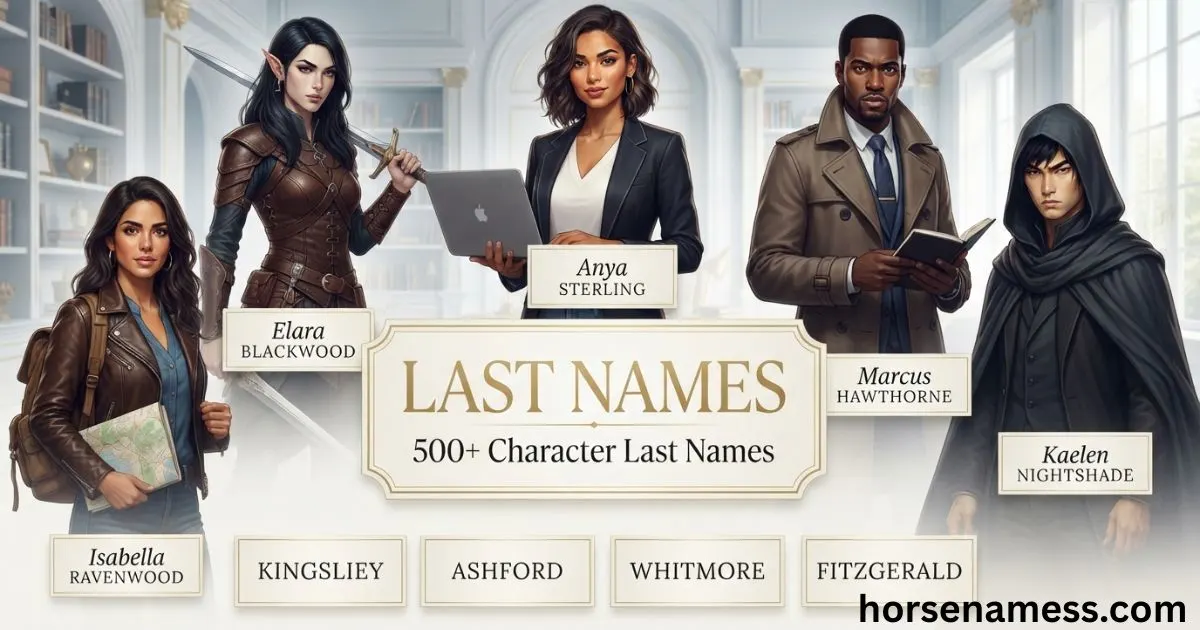
500+ Character Last Names Cool & Unique Surname Ideas
Character last names can turn a simple first name into someone readers remember. The right surname, family name, fictional identity, character archetype, or genre-specific name can suggest personality, history, culture, or social status before the character even speaks.
After working with character naming patterns, I’ve found the hardest part is rarely finding a surname it is finding one that actually belongs to the person on the page. A strong fictional surname, fantasy name, historical name, meaningful last name, or story character name should sound natural beside the first name while fitting the setting. The ideas below organize character last names around the same patterns writers commonly use: personality, genre, period, location, culture, and story role.
Top 10 Character Last Names: Editor’s Picks
Our curated favorites with meanings and best-use cases:
- Steele — Hard as steel; best for a strong hero.
- Graves — Dark association; best for a mysterious villain.
- Sterling — Precious and valuable; best for a wealthy character.
- Hawke — Sharp and keen; best for an edgy protagonist.
- Blackwood — Dark authority; best for a powerful antagonist.
- Rivers — Flowing and natural; best for a nature-loving character.
- Windsor — Royal heritage; best for a royal character.
- Thorn — Sharp and dangerous; best for a fierce character.
- Fairchild — Lovely and innocent; best for a pretty character.
- Nightingale — Rare songbird; best for a unique character.
Last Names for Characters
The best character last names feel connected to the world around them. A detective might need a surname with a crisp, memorable sound, while a fantasy heir may need something older and more ceremonial. Consider pronunciation, meaning, personality, setting, and genre conventions before making your final choice.
A useful trick is to say the complete name aloud several times. Notice its rhythm, initials, repeated sounds, and emotional impression. Then imagine it appearing on a book cover, dialogue line, character sheet, or movie credit. If it still feels natural after hearing it repeatedly, you may have found the right surname.
How to Choose a Last Name for a Character
When choosing a surname, begin with the character’s personality, role, appearance, genre, and time period. Listophile specifically recommends considering sound, pronunciation, meaning, genre, historical period, and theme. Those details prevent a beautiful surname from feeling disconnected from the person carrying it.
| Character trait | Surname direction | Examples |
| Brave | Strong, compact | Steele, Knox, Armstrong |
| Wealthy | Aristocratic or polished | Carrington, Cavendish, Wellington |
| Mysterious | Dark or unusual | Graves, Crowe, Hawke |
| Nature-loving | Earth or landscape | Rivers, Woods, Reed |
| Magical | Mythic or atmospheric | Luna, Griffin, Fontaine |
| Traditional | Familiar surname | Brown, Carter, Wilson |
The goal is not to make the meaning painfully obvious. A subtle connection can be more effective than a surname that announces the character’s personality. A quiet character called Stone may feel more intriguing than a villain literally named “Evilman.”
Last Names for Male Characters
Male Character last names surnames can range from ordinary family names to dramatic names suited to heroes, detectives, soldiers, athletes, or fantasy protagonists. Competitor examples include Bowman, Carson, Hudson, Hunt, Lawson, Marshall, and Nelson, showing how familiar surnames can still work effectively in fiction.
For a modern American character, realistic surnames such as Carter, Brooks, Bennett, Parker, Morgan, Hayes, Walker, or Reed can feel natural without overpowering the first name. For a more dramatic protagonist, names such as Knox, Sterling, Steele, Maverick, or Lockhart create a stronger fictional presence.
Last Names for Female Characters
Female Character last names do not need to follow a separate naming rule, but certain names can create an elegant, strong, romantic, mysterious, or contemporary impression. Listophile gives examples including Blakely, Harper, Kennedy, Madison, McKenzie, Quinn, and Reagan.
Try pairing a softer first name with a sharper surname, or reverse the pattern for contrast. Clara Quinn, Elena Stone, Maya Sterling, and Nora Blackwell each create different impressions. The important relationship is between the complete name, the character’s personality, and the atmosphere of the story.
Last Names for Heroes
Heroic Character last names often suggest strength, courage, leadership, resilience, or independence. Listophile’s hero examples include Lockhart, Magnuson, Masters, Maverick, McKnight, Steele, and Sterling. These names demonstrate how a surname can quietly reinforce the role a character plays.
A hero does not necessarily need an extraordinary surname. In fact, an ordinary name can make an extraordinary character feel more grounded. Think about Parker, Bennett, Carter, Walker, Brooks, or Hayes for contemporary fiction, while Sterling, Lockhart, or McKnight may suit a more heightened adventure.
Last Names for Villains
Villain surnames frequently use darker sounds, sharp consonants, historical associations, or meanings that hint at danger. Listophile includes examples such as Grimes, Hatchett, Nash, Salem, Snyder, Sweeney, and Vargas in its villain category.
Subtlety matters. A villain named Graves immediately creates a dark association, while Mercer or Crawford can appear completely ordinary until readers learn what the character has done. That contrast can make a villain more believable and prevent the name from becoming predictable.
Last Names for Fantasy Characters
Fantasy Character last names can draw from mythology, landscapes, medieval naming patterns, ancient languages, noble houses, or invented linguistic structures. Listophile includes fantasy examples such as Ajax, Cordero, Cortez, Kincaid, Kramer, Sisko, and Stryker, while PrepScholar also maintains a dedicated fantasy category.
For original fantasy worlds, decide whether surnames should sound familiar or completely invented. Ashford, Thornwood, Silvermere, Ravenshade, and Winterborne create an immediately fantastical atmosphere, while names such as Bennett or Carter can make the same world feel closer to modern historical fiction.
Last Names for Unique Characters
Unique Character last names work best when they remain pronounceable and memorable. Listophile’s examples include Eden, Hawke, Hunter, Knightley, Palmer, Rivers, and Ventura. A distinctive surname does not necessarily need unusual spelling; sometimes an unexpected combination creates enough individuality.
Consider the difference between unusual and difficult. A reader should ideally recognize the surname again after seeing it once or twice. Names such as Hawke, Rivers, Wilder, Sterling, or Ventura stand out without requiring the reader to stop and decode every syllable.
Last Names for Royal Characters
Royal Character last names often suggest dynasty, inheritance, nobility, territory, power, or ancient family history. Examples from Listophile include Aragon, Burgundy, Mountbatten, Orleans, Savoy, Saxony, and Windsor.
For fictional royalty, you can combine a recognizable surname with a fictional first name or create a house name based on geography. House Valemont, Aurelia Windsor, or Julian Montfort can signal social status without requiring lengthy exposition.
Last Names for Medieval Characters
Medieval Character last names should match the social and geographical world of the story rather than simply sounding old. Listophile provides examples including Albrecht, Gervaise, Heinrich, Hildebrand, Kimball, Maynard, and Wainwright.
Historical research becomes especially valuable here. A surname that sounds medieval to a modern reader may not actually fit the region or period being portrayed. Think about whether the character is a noble, merchant, craftsman, soldier, farmer, or member of a ruling family before choosing the surname.
Last Names for Science-Fiction Characters
Science-fiction surnames can represent future societies, space travel, technology, alien cultures, colonies, or altered naming conventions. PrepScholar’s sci-fi examples include Alastair, Aphelion, Callisto, Chrysalis, Nadir, Omega, Sapphirus, Silvius, Umbra, and Zibia.
A futuristic surname does not always need strange spelling. Names such as Mercer, Vega, Sterling, Orion, or Vale can feel futuristic when paired with the right first name and setting. For alien cultures, develop a consistent sound system so names feel related without becoming interchangeable.
Last Names for Nature and Earthy Characters
Nature-themed surnames can evoke forests, rivers, mountains, plants, weather, landscapes, and animals. Listophile’s examples include Banks, Ford, Reed, Stone, Warren, West, and Woods.
These names work especially well for contemporary fiction, fantasy, rural stories, and characters with strong environmental connections. A surname such as Rivers can feel gentle, while Stone feels harder and more grounded. The meaning creates atmosphere without requiring a direct explanation.
Last Names for Scary and Creepy Characters
Creepy character surnames often use associations with death, darkness, isolation, storms, ghosts, or unsettling places. Listophile includes Breaker, Calderon, Heller, Howler, Loveless, Snead, and Snell in this category.
For horror writing, restraint can make the effect stronger. Graves, Crowe, Holloway, Blackwood, or Mortimer can suggest unease while still functioning as plausible surnames. A frightening name becomes especially effective when the character initially appears completely ordinary.
Non-Modern Surname Ideas
Non-modern surnames can help establish a fantasy, historical, dystopian, or futuristic setting. Samantha Types discusses patronymic and matronymic systems, along with locations and titles, as ways to move beyond modern surname conventions.
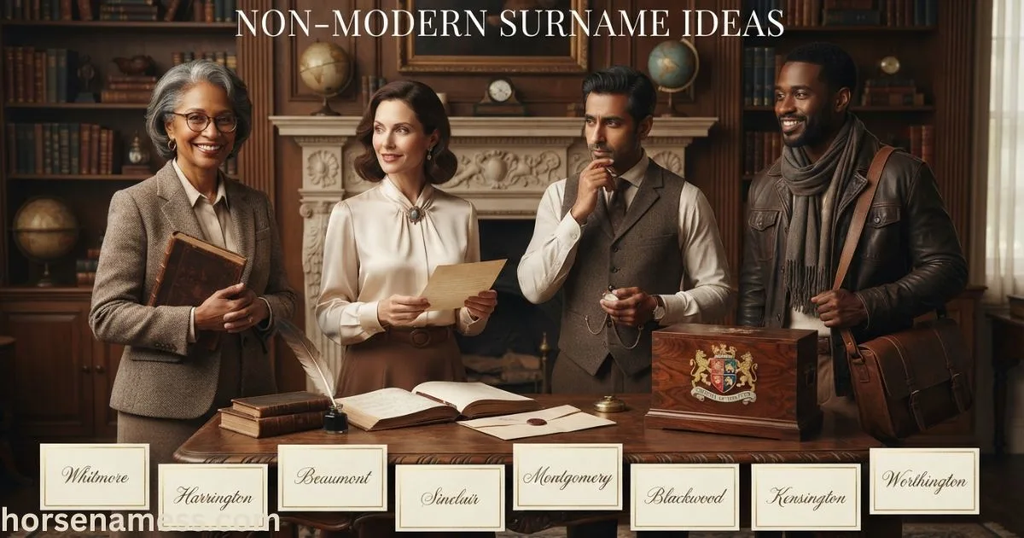
For a fictional culture, consider how family identity is inherited. A society might use the father’s name, mother’s name, occupation, location, clan, title, or house. This creates a naming system rather than a random collection of unusual surnames, making the fictional world feel more coherent.
International
International surnames can give characters a stronger connection to their cultural or geographical setting. Samantha Types includes an international collection containing surnames from many backgrounds, demonstrating how writers can move beyond a single naming tradition.
When using culturally specific surnames, research the actual naming conventions behind them. Pay attention to spelling, pronunciation, regional usage, compound surnames, and whether a name is genuinely used as a family name. Authenticity generally comes from understanding the naming system rather than simply selecting a surname that sounds foreign.
Inventive
Inventive surnames are useful when your story requires a fictional family, fantasy culture, futuristic society, or entirely original setting. Samantha Types separates inventive names from traditional and international choices and includes a large collection of unusual constructions.
A good invented surname usually follows a pattern. Decide which sounds, syllables, endings, or combinations belong to the culture before generating several names. If one family uses -vale, another uses -thorn, and another uses -mere, the reader can begin recognizing relationships between fictional houses.
Tip 1: Consider the Character’s Age
A surname should make sense for the character’s generation and the period in which the story takes place. PrepScholar points out that surname popularity changes over time, meaning a name appropriate for a modern teenager may feel strange for an ancient or historical character.
Tip 2: Stick to the Location of the Story
Location strongly influences believable character names. PrepScholar recommends respecting the naming conventions of the story’s setting rather than mixing unrelated cultural traditions without purpose. A character from ancient Rome, for example, requires a different naming approach from someone living in contemporary Chicago.
Tip 3: Follow the Genre
Genre creates expectations around character names. Fantasy may tolerate elaborate or invented surnames, while contemporary romance may favor recognizable names. Mystery, western, horror, and science fiction each create different expectations. Choosing a surname that supports those conventions helps readers enter the story more quickly.
Tip 4: Think of Other Characters
Check the surnames of your entire cast before finalizing a character name. PrepScholar warns that names that look or sound too similar can make readers confuse characters. Beauchamp and Beaufort, for example, may be harder to distinguish than surnames with more contrasting sounds.
Tip 5: Consider Your Character’s Qualities
A surname can quietly reinforce character qualities such as bravery, kindness, ambition, danger, intelligence, elegance, or mystery. PrepScholar recommends considering what the name means and whether that meaning supports the character without accidentally revealing an important plot development.
Conclusion
The best character last names do more than finish a full name they help establish identity, setting, personality, culture, and story atmosphere. Whether you need a surname for a hero, villain, fantasy character, royal, detective, romance lead, sci-fi protagonist, medieval warrior, or original fictional family, the strongest choice is one that belongs naturally to the world you have created.
Before deciding, say the complete name aloud, check its meaning, consider the character’s age and location, compare it with other characters, and make sure its sound fits the genre. A surname like Rivers, Sterling, Graves, Hawke, Windsor, Blackwood, or Mercer can create a different emotional impression but the character you build around it is what ultimately gives the name its power. For more naming ideas, explore our Valyrian names, butler names, and funny A names.
Last Names for Characters by Personality
Beyond genre and setting, a surname can capture who your character is. These personality-based last names instantly signal beauty, wealth, charm, toughness, elegance, rarity, or power.
Last Names for Pretty Characters
Soft, melodic surnames for beautiful and graceful characters.
- Rosenthal — rose valley, romantic and lovely
- Bellefleur — beautiful flower
- Fairchild — lovely and innocent
- Lovelace — charming and delicate
- Marigold — golden and radiant
- Seraphine — angelic beauty
- Blossom — fresh and blooming
- Winslow — gentle and refined
Last Names for Rich Characters
Opulent surnames that sound like old money and high society.
- Winchester — established wealth
- Beaumont — beautiful mountain, aristocratic
- Carrington — grand estate energy
- Delacroix — of the cross, old-world riches
- Harrington — distinguished and affluent
- Pemberton — landed gentry
- Sterling — precious and valuable
- Vanderbilt — iconic fortune
Last Names for Cute Characters
Adorable, friendly surnames for lovable characters.
- Button — cute as a button
- Honeycutt — sweet as honey
- Puddleduck — playful and endearing
- Sweetwater — gentle and kind
- Dimple — cheerful charm
- Cupcake — sugary sweet
- Snuggles — warm and cuddly
- Peaches — soft and delightful
Last Names for Badass Characters
Tough, edgy surnames for fearless characters who take no prisoners.
- Stone — unbreakable
- Ryder — rides into danger
- Wolfe — predator instinct
- Blaze — fiery and fierce
- Steele — hard as steel
- Hunter — relentless tracker
- Reaper — deadly reputation
- Thorn — sharp and dangerous
Last Names for Fancy Characters
Elegant, sophisticated surnames for refined and stylish characters.
- Ashworth — polished and proper
- Sinclair — noble and distinguished
- Chamberlain — courtly elegance
- Delacroix — French sophistication
- Fairfax — fair and lovely
- Kensington — upscale London charm
- Montgomery — classic refinement
- Whitmore — crisp and classy
Last Names for Rare Characters
Uncommon surnames for one-of-a-kind characters.
- Quill — writerly and unique
- Nightingale — rare songbird
- Starling — uncommon and bright
- Wilde — untamed originality
- Marlowe — literary rarity
- Foxglove — wildflower uncommon
- Rook — dark and distinctive
- Sable — rare and luxurious
Last Names for Powerful Characters
Commanding surnames for leaders, rulers, and forces of nature.
- Ironheart — unyielding strength
- Stormborn — born of thunder
- Blackwood — dark authority
- Thunderstrike — raw power
- Goldmane — regal dominance
- Oakenshield — immovable protector
- Ravensworth — ominous command
- Dragonsbane — legendary might
FAQ Section
What makes a good last name for a character?
A good fictional surname should fit the character’s personality, setting, genre, period, culture, and first name. It should also be easy enough to pronounce and remember. Meaning can add another layer of characterization when used subtly.
How do I choose a last name for a fictional character?
Start with the character’s role and story setting. Then consider the historical period, cultural naming conventions, surname meaning, pronunciation, and how the complete first-and-last name sounds together.
Should fantasy characters have unusual last names?
Not necessarily. Fantasy characters can use familiar, historical, invented, or highly unusual surnames. The important thing is consistency. If the fictional culture has recognizable naming patterns, individual surnames will feel more believable.
How do I create a realistic fictional surname?
Study real surname patterns based on occupations, locations, family lineage, geography, languages, and historical naming systems. Then adapt those patterns instead of randomly combining unusual sounds.
Can I use real last names for fictional characters?
Yes. Real surnames are commonly used in fiction. However, writers should consider whether a particular surname has strong real-world associations that could unintentionally affect how readers interpret the character.
What are good last names for villains?
Examples include Graves, Crowe, Salem, Blackwood, Heller, Mortimer, and Wolfe. Dark associations can create an ominous impression, although an ordinary surname can sometimes make a villain feel more realistic.
What are good last names for fantasy characters?
Fantasy-friendly examples include Kincaid, Lockhart, Sterling, Hawke, Ravenswood, Thornmere, Winterborne, and Blackwood. The best option depends on whether the world feels medieval, magical, mythological, dark, or whimsical.
How can I stop character surnames from sounding too similar?
Write the full cast’s surnames in one list and compare their spelling, pronunciation, syllable count, and first letters. If two names could easily be confused while reading quickly, replace one with a more distinctive option.

Morgan is a horse naming enthusiast and equestrian content writer with a passion for helping horse owners find the perfect names for their equine companions. From classic and elegant names to unique, Western, funny, and breed-specific ideas, Morgan creates well-researched, easy-to-browse name collections designed to inspire every horse lover. The goal is to make choosing the right horse name simple, enjoyable, and memorable.