Names of Teeth Types, Numbers, Functions & Full Guide
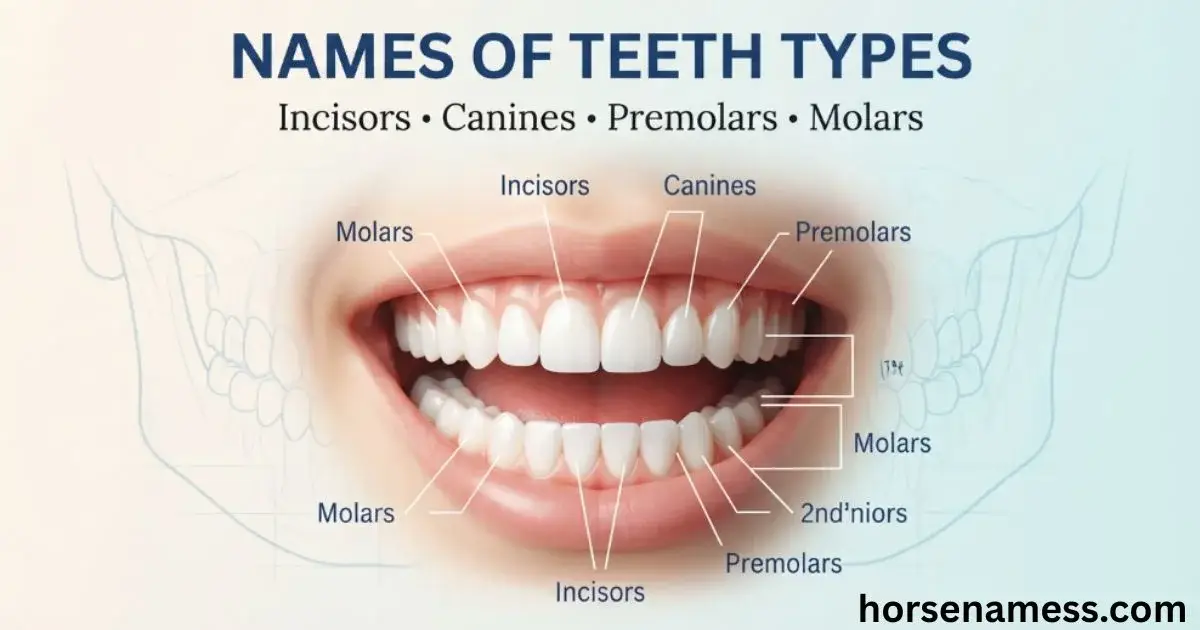
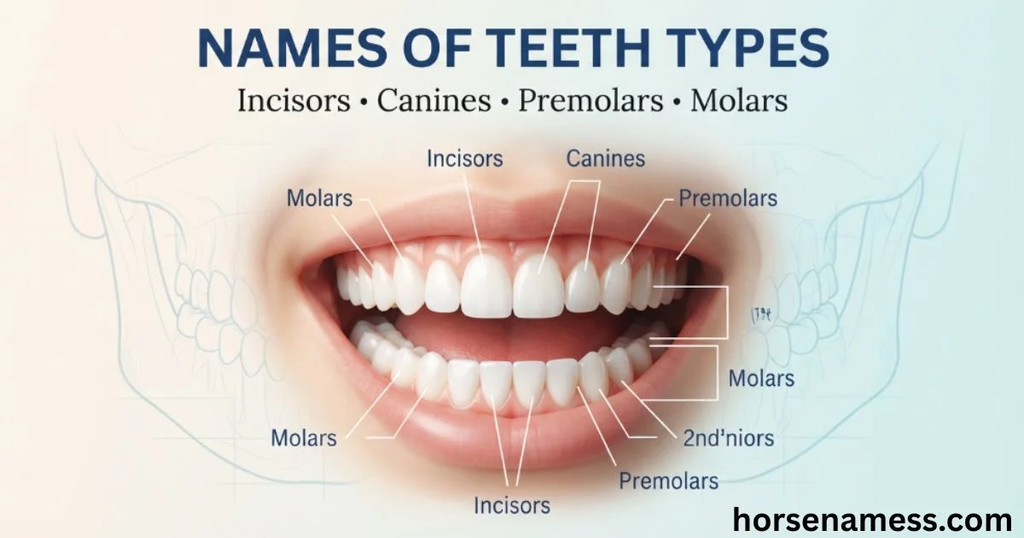
The names of teeth describe four main groups: incisors, canines, premolars, and molars. Each type has a particular location, shape, and function, helping you bite, tear, crush, and grind food. Understanding these terms can make dental charts, X-rays, and treatment conversations easier to follow.
If dental terminology has ever felt confusing, you are not alone. A phrase such as “upper-left first molar” may sound complicated, but it simply combines a tooth’s position, type, and side. This guide explains tooth names, dental anatomy, tooth numbers, primary teeth, and permanent teeth in clear language, using terminology relevant to patients in the United States.
Teeth at a Glance: The 4 Main Types
If you only remember four things about teeth names, make it these — the four groups every dentist uses:
- Incisors — 8 total (4 upper, 4 lower); they cut and bite; the flat front teeth you see when you smile.
- Canines — 4 total; they grip and tear; the pointed “eye teeth” beside the incisors.
- Premolars — 8 total; they crush food; also called bicuspids, sitting between canines and molars.
- Molars — up to 12 total; heavy grinding; includes the wisdom teeth at the very back.
Names of Teeth: Teeth Names and Numbering
Dentists use tooth names and numbers to identify a specific tooth accurately. Names such as central incisor, canine, first premolar, and third molar describe the tooth, while the Universal Numbering System assigns permanent teeth numbers from 1 through 32 in the United States.
Universal numbering system
The U.S. Universal Numbering System begins with the upper-right third molar, numbered #1, and continues across the upper arch to #16. It then moves to the lower-left third molar, #17, and finishes at the lower-right third molar, #32.
U.S. Universal Tooth Numbering Chart
| Number | Tooth name |
| #1 | Upper-right third molar |
| #2 | Upper-right second molar |
| #3 | Upper-right first molar |
| #4 | Upper-right second premolar |
| #5 | Upper-right first premolar |
| #6 | Upper-right canine |
| #7 | Upper-right lateral incisor |
| #8 | Upper-right central incisor |
| #9 | Upper-left central incisor |
| #10 | Upper-left lateral incisor |
| #11 | Upper-left canine |
| #12 | Upper-left first premolar |
| #13 | Upper-left second premolar |
| #14 | Upper-left first molar |
| #15 | Upper-left second molar |
| #16 | Upper-left third molar |
| #17 | Lower-left third molar |
| #18 | Lower-left second molar |
| #19 | Lower-left first molar |
| #20 | Lower-left second premolar |
| #21 | Lower-left first premolar |
| #22 | Lower-left canine |
| #23 | Lower-left lateral incisor |
| #24 | Lower-left central incisor |
| #25 | Lower-right central incisor |
| #26 | Lower-right lateral incisor |
| #27 | Lower-right canine |
| #28 | Lower-right first premolar |
| #29 | Lower-right second premolar |
| #30 | Lower-right first molar |
| #31 | Lower-right second molar |
| #32 | Lower-right third molar |
The chart follows the patient’s perspective, not the viewer’s perspective when looking directly at another person. A dentist may use additional notation systems depending on location, education, and professional context.
FDI notation system
The FDI notation system uses two digits. The first identifies the quadrant, while the second identifies the tooth’s position within that quadrant. For example, the second premolar in the upper-left permanent quadrant is designated 25 in the FDI system.
Palmer notation system
How are teeth named and numbered?
A tooth’s full descriptive name can combine its dentition, jaw, side, tooth type, and position within that type. For example, “permanent mandibular right lateral incisor” tells you the tooth is permanent, located in the lower jaw, on the patient’s right side, and is the lateral incisor.
Dentists use numbering systems because saying a complete anatomical description every time would be cumbersome. The U.S. Universal system numbers permanent teeth from 1 through 32, while FDI notation uses two digits to identify the quadrant and tooth position.
| Identification detail | Example |
| Dentition | Permanent |
| Jaw | Mandibular |
| Side | Right |
| Tooth type | Lateral incisor |
| Full name | Permanent mandibular right lateral incisor |
| U.S. number | #26 |
One important detail is perspective. Dental charts may be shown from the patient’s view or a clinician’s view, so “right” and “left” can initially seem reversed. The safest approach is to follow the chart’s stated orientation rather than assuming the image is a mirror.
Other teeth names
Some teeth have everyday or alternative dental names. Canines are also called cuspids or sometimes eye teeth, while premolars are commonly called bicuspids. Third molars are better known as wisdom teeth. These names can appear on dental websites, charts, records, or conversations with patients.
There are also broader location terms. Anterior teeth generally refer to the front teeth, while posterior teeth refer to teeth toward the back. Maxillary means related to the upper jaw, and mandibular means related to the lower jaw.
| Common name | Professional term |
| Front teeth | Incisors |
| Eye teeth / cuspids | Canines |
| Bicuspids | Premolars |
| Wisdom teeth | Third molars |
| Upper teeth | Maxillary teeth |
| Lower teeth | Mandibular teeth |
| Front group | Anterior teeth |
| Back group | Posterior teeth |
Teeth Numbers by Jaw Quadrant
Each jaw quadrant holds eight permanent teeth. The tables below map every U.S. Universal number (#1–#32) to its tooth name, quadrant by quadrant.
Upper right jaw: teeth #1–#8
Under the U.S. Universal system, the upper-right jaw contains teeth #1 through #8. Starting at the far back, the sequence is third molar, second molar, first molar, second premolar, first premolar, canine, lateral incisor, and central incisor.
| U.S. number | Tooth |
|---|---|
| #1 | Third molar / wisdom tooth |
| #2 | Second molar |
| #3 | First molar |
| #4 | Second premolar |
| #5 | First premolar |
| #6 | Canine / cuspid |
| #7 | Lateral incisor |
| #8 | Central incisor |
Upper left jaw: teeth #9–#16
The upper-left jaw contains teeth #9 through #16. Unlike the upper-right sequence, this side begins at the front with #9, the central incisor, and progresses toward the back until #16, the third molar.
| U.S. number | Tooth |
|---|---|
| #9 | Central incisor |
| #10 | Lateral incisor |
| #11 | Canine / cuspid |
| #12 | First premolar |
| #13 | Second premolar |
| #14 | First molar |
| #15 | Second molar |
| #16 | Third molar / wisdom tooth |
Lower left jaw: teeth #17–#24
The lower-left jaw begins with #17, the third molar, and moves forward toward #24, the central incisor. The pattern mirrors the upper arch but continues the Universal numbering sequence after #16.
| U.S. number | Tooth |
|---|---|
| #17 | Third molar / wisdom tooth |
| #18 | Second molar |
| #19 | First molar |
| #20 | Second premolar |
| #21 | First premolar |
| #22 | Canine / cuspid |
| #23 | Lateral incisor |
| #24 | Central incisor |
Lower right jaw: teeth #25–#32
The lower-right jaw contains teeth #25 through #32. The sequence begins with the central incisor at #25 and moves outward through the lateral incisor, canine, premolars, molars, and finally the third molar at #32.
| U.S. number | Tooth |
|---|---|
| #25 | Central incisor |
| #26 | Lateral incisor |
| #27 | Canine / cuspid |
| #28 | First premolar |
| #29 | Second premolar |
| #30 | First molar |
| #31 | Second molar |
| #32 | Third molar / wisdom tooth |
Names of Teeth: The Four Main Types of Teeth and What They Do
The four principal types of permanent teeth are incisors, canines, premolars, and molars. Their shapes reflect their jobs: incisors have cutting edges, canines have pointed cusps, and premolars and molars have broader surfaces for crushing and grinding.
| Tooth type | Adult number | Main function | Typical location |
| Incisors | 8 | Biting and cutting | Front of the mouth |
| Canines | 4 | Gripping and tearing | Beside the incisors |
| Premolars | 8 | Crushing and assisting grinding | Behind the canines |
| Molars | Up to 12 | Crushing and grinding | Back of the mouth |
Names of Teeth: Incisors, Canines, Premolars and Molars
Incisors are the front teeth and include central and lateral incisors. Canines, also called cuspids or eyeteeth, sit beside the lateral incisors. Premolars lie behind the canines, and molars occupy the back of the dental arch. Together, these groups support the mechanical breakdown of food.
Incisors
Adults generally have eight incisors: four central incisors and four lateral incisors. Their relatively flat, sharp edges help cut and bite food. The central incisors sit nearest the middle of the mouth, while lateral incisors are positioned immediately beside them.
Canines
Canines are the pointed teeth located between the incisors and premolars. They are also known as cuspids and, particularly when referring to upper teeth, eyeteeth. Their shape helps grip and tear food during chewing.
Premolars
Premolars are located between the canines and molars. Permanent dentition usually includes first and second premolars in each quadrant. Their raised cusps help crush food and transition it toward the grinding surfaces of the molars.
Molars
Molars are the broad teeth at the back of the mouth. First and second molars are permanent teeth, while third molars are commonly called wisdom teeth. Their larger surfaces are adapted to crushing and grinding food.
How do teeth function?
Your teeth work as a coordinated system rather than as isolated structures. Incisors cut, canines tear, premolars crush, and molars grind. The tongue then helps gather processed food into a bolus that can be swallowed. This division of labor explains why tooth shapes differ so noticeably.
Teeth also contribute to speech and facial structure. Incisors, for example, interact with the lips and tongue during certain speech sounds, while teeth and their supporting structures help maintain the form of the dental arches and lower face.
Names of Teeth: How Teeth Are Named by Position
A tooth’s full description can combine its jaw, side, position, and type. For example, “upper-left first molar” identifies a molar in the upper jaw on the patient’s left side. This terminology gives dental professionals a precise way to communicate about a specific tooth.
The word maxillary refers to the upper jaw, which contains the maxillary teeth. Mandibular refers to the lower jaw, which contains the mandibular teeth. These terms often appear in dental reports, anatomy textbooks, and X-ray explanations.
Common front-to-back tooth sequence
From the center of a quadrant toward the back, permanent teeth generally follow this pattern:
Central incisor → lateral incisor → canine → first premolar → second premolar → first molar → second molar → third molar
This sequence is repeated across the four quadrants, although the numbering depends on the system being used.
Names of Teeth: Upper and Lower Teeth
The upper teeth are called maxillary teeth because they are located in the maxilla. The lower teeth are called mandibular teeth because they are positioned in the mandible. Both arches work together during biting, chewing, speech, and maintaining the shape of the lower face.
When a dentist says “lower-right molar,” the phrase gives information about both location and tooth type. This is useful when discussing a cavity, filling, crown, extraction, dental X-ray, or other treatment-related matter.
Names of Teeth: Baby Teeth and Adult Teeth: What Changes Over Time?
Children generally develop 20 primary teeth, commonly called baby teeth or milk teeth. The primary set contains eight incisors, four canines, and eight molars. Unlike permanent dentition, primary dentition does not contain premolars.
Names of Teeth: Primary and Permanent Dentition
Primary dentition refers to a child’s first set of teeth. Permanent dentition refers to the adult set, which can contain up to 32 teeth when all four wisdom teeth are present. Primary teeth help children chew, speak, and preserve space for developing permanent teeth.
| Feature | Primary teeth | Permanent teeth |
| Common name | Baby teeth | Adult teeth |
| Typical total | 20 | Up to 32 |
| Incisors | 8 | 8 |
| Canines | 4 | 4 |
| Premolars | 0 | 8 |
| Molars | 8 | Up to 12 |
As permanent teeth emerge, primary teeth may loosen and fall out. The timing differs between children, so parents should discuss unusual eruption patterns, pain, or concerns with a dental professional.
Names of Teeth: How Many Teeth Do Humans Have?
Most adults have up to 32 permanent teeth, including four third molars. The total includes eight incisors, four canines, eight premolars, and twelve molars when all third molars are present. Some adults have fewer teeth because wisdom teeth may not develop, may remain impacted, or may have been removed.
Children generally have 20 primary teeth. These consist of eight incisors, four canines, and eight molars. The number of teeth present at a particular age can vary because eruption and replacement occur over several years.
Names of Teeth: Adult Teeth Chart
| Adult tooth group | Number |
| Central incisors | 4 |
| Lateral incisors | 4 |
| Canines | 4 |
| First premolars | 4 |
| Second premolars | 4 |
| First molars | 4 |
| Second molars | 4 |
| Third molars | Up to 4 |
Third molars are counted as molars even when they are absent. Therefore, the phrase “32 adult teeth” describes the usual full permanent set rather than a number that every adult necessarily has.
Names of Teeth: Basic Tooth Anatomy Patients Should Know
Tooth names identify the type and location of a tooth, but anatomy explains its structure. A tooth includes the crown, enamel, dentin, pulp, neck, and root. These parts work together to provide strength, protection, sensation, and attachment within the jaw.
Names of Teeth: Crown, Enamel, Dentin, Pulp and Root
The crown is the visible part above the gumline. Enamel covers and protects the crown, while dentin lies beneath it. The pulp contains nerves and blood vessels. The root extends into the supporting structures and helps anchor the tooth.
| Tooth part | Basic role |
| Crown | Visible part of the tooth |
| Enamel | Hard outer protective layer |
| Dentin | Layer beneath enamel |
| Pulp | Inner tissue containing nerves and blood vessels |
| Neck | Area near the gumline |
| Root | Anchors the tooth |
| Root canal | Passage associated with the pulp tissue |
Understanding these terms can make dental explanations less intimidating. However, only a qualified dental professional can determine the cause and severity of a specific symptom.
Teeth anatomy
Dental anatomy examines not only tooth names but also the structures that support teeth. Anatomy resources commonly discuss tooth groups, numbering systems, tooth structure, blood supply, and nerves.
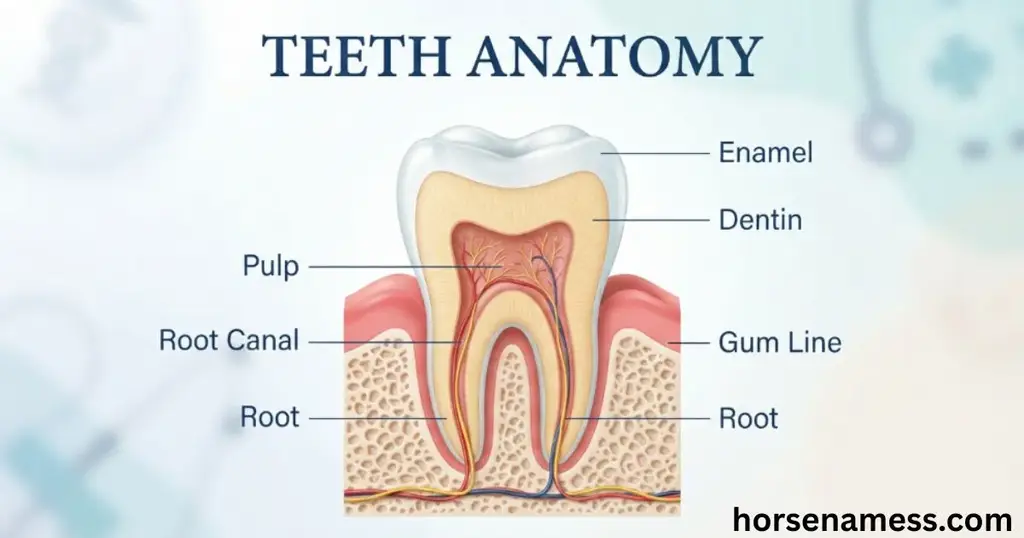
Tooth structure
The tooth structure includes the crown, pulp chamber, neck, root, and root canal. The exact anatomy varies between tooth types, which is one reason incisors, canines, premolars, and molars have different shapes and functions.
Arteries and veins
Teeth receive blood supply through vessels associated with the jaw and surrounding tissues. Dental anatomy references describe superior alveolar and inferior alveolar vessels in relation to the teeth. This subject is more relevant to dental students and clinical professionals than to basic patient terminology.
Nerves
Dental nerves carry sensory information and are associated with branches of the trigeminal nerve. The pulp contains important nerve and vascular tissues, which helps explain why problems affecting deeper tooth structures can produce sensitivity or pain.
Creative & Funny Teeth Names
Beyond their clinical names, teeth have inspired a world of creative nicknames. From funny puns like Toothzilla and Giggle Biter to fantasy-inspired names such as Dragon Fang, these playful labels give ordinary teeth a personality of their own — perfect for stories, games, classroom activities, or just for fun.
Funny Teeth Names
Giggle Biter, Chompy Champ, Snack Attack Tooth, Sir Munch-a-Lot, Toothzilla, Crunch Master, Jelly Snapper, Dr. Bitey, Mr. Nibble, Popcorn Cruncher, Banana Biter, Laughing Fang, Sugar Snap, Goofy Grinder, Bubblegum Biter, Wacky Whitie, Captain Chomp, Professor Plaque, Sir Gnashalot, Molar McFunny
Cool Teeth Names
Frost Fang, Steel Bite, Ice Chomper, Shadow Tooth, Neon Fang, Thunder Bite, Silver Snap, Crystal Cutter, Night Grinder, Blaze Tooth, Storm Biter, Urban Fang, Alpha Tooth, Titan Snap, Ghost Grinder, Venom Bite
Cute Teeth Names
Baby Bite, Sugar Tooth, Candy Chomp, Peachy Snap, Tiny Nibbles, Sweetie Tooth, Muffin Muncher, Love Bite, Pinky Fang, Cookie Crunch, Bunny Bite, Cupcake Tooth, Daisy Snap, Jelly Bean Bite, Angel Tooth, Marshmallow Munch
Scary Teeth Names
Dark Fang, Doom Chomper, Skull Bite, Blood Snap, Horror Grinder, Phantom Tooth, Nightmare Fang, Devil Bite, Haunted Chomp, Death Grinder, Evil Snapper, Grave Bite, Monster Fang, Toxic Tooth, Shadow Chomp, Cursed Cutter
Fantasy Teeth Names
Dragon Fang, Wizard Bite, Elf Tooth, Magic Chomper, Crystal Fang, Phoenix Bite, Enchanted Snap, Mystic Grinder, Spell Tooth, Fairy Fang, Rune Bite, Kingdom Chomp, Elven Snap, Myth Tooth, Potion Grinder, Ancient Fang
Animal-Inspired Teeth Names
Lion Bite, Tiger Fang, Shark Chomper, Wolf Snap, Bear Grinder, Eagle Tooth, Fox Bite, Croc Fang, Panther Snap, Bunny Chomp, Snake Bite, Dolphin Tooth, Horse Grinder, Owl Fang, Leopard Snap, Rhino Bite
Food-Inspired Teeth Names
Burger Bite, Pizza Chomp, Taco Tooth, Donut Snap, Cookie Fang, Chocolate Bite, Candy Grinder, Mango Chomp, Apple Snap, Banana Tooth, Ice Cream Bite, Noodle Fang, Pancake Snap, Cheese Chomp, Strawberry Bite, Muffin Tooth
Unique & Weird Teeth Names
Zorblax Bite, Moonfang, Nebula Tooth, Quantum Chomp, Pixel Fang, Cosmic Snap, Void Grinder, Electric Tooth, Plasma Bite, Astro Chomp, Galaxy Fang, Meteor Snap, Orbit Tooth, Stellar Bite, Infinity Grinder, Dream Fang
How to Create Your Own Teeth Names
Pick a theme (funny, scary, cute, fantasy, food, or animals), choose a base word such as bite, fang, tooth, chomp, snap, or grinder, add a personality word like brave, goofy, royal, or mysterious, combine the words, say the result aloud to check its rhythm, and make sure it suits your story, game, or activity.
Creative naming can also make dental care feel more approachable, especially for children. You might invent a short story in which each tooth has a job — incisors as front-line cutters, canines as warriors, and molars as heavy lifters — to make brushing time more engaging.
Why Knowing Teeth Names Matters in Dental Care
Knowing the names of teeth can make dental conversations easier to understand. If a dentist refers to a lower-left first molar, you can connect the term with a specific area of the mouth instead of treating it as an unfamiliar medical code.
Tooth terminology can also help when reading a dental chart, reviewing an X-ray, discussing a filling, or asking questions about a treatment plan. It does not mean you need to memorize every numbering system or diagnose a dental condition yourself.
If you experience persistent tooth pain, swelling, bleeding, sensitivity, or a damaged tooth, seek advice from a qualified dental professional. A tooth’s name can help describe the problem, but it cannot replace an examination.
Conclusion
Learning the names of teeth becomes easier when you connect each tooth with its position and purpose. Incisors cut, canines tear, premolars crush, and molars grind. Understanding the difference between primary and permanent teeth, maxillary and mandibular teeth, and common numbering systems can help you communicate more confidently during dental visits.
You do not need to memorize every technical term at once. Start with the four main tooth groups, learn the front-to-back sequence, and use a reliable dental chart when you need to identify a specific tooth. If you have pain or another dental concern, use this information as a communication aid and consult a qualified dentist for professional guidance. For more naming inspiration, explore our funny names, joke names, and fantasy names collections.
FAQs
What are the main teeth names?
The four main types of teeth are incisors, canines, premolars, and molars. Incisors cut, canines grip and tear, premolars crush, and molars primarily grind food.
How many teeth do adults usually have?
Adults can have up to 32 permanent teeth, including four wisdom teeth. Some adults have fewer because wisdom teeth may be absent, impacted, or removed.
How many teeth do children have?
Children generally have 20 primary teeth: eight incisors, four canines, and eight molars. Primary teeth do not include premolars.
What is the difference between premolars and molars?
Premolars are positioned between canines and molars and help crush food. Molars are larger back teeth designed primarily for crushing and grinding.
Are wisdom teeth considered molars?
Yes. Wisdom teeth are the third molars. They are located at the back of the mouth and may erupt normally, remain impacted, or never develop.
What is an eyetooth?
An eyetooth is another name for a canine, especially an upper canine. The terms canine and cuspid are more common in professional dental communication.
What is tooth number 8?
In the U.S. Universal Numbering System, tooth #8 is the upper-right central incisor from the patient’s perspective. The same tooth can have a different identifier in another numbering system.
What is tooth number 19?
Tooth #19 in the U.S. Universal Numbering System is the lower-left first molar from the patient’s perspective.
Why do dentists use numbers as well as tooth names?
Numbers help dentists identify individual teeth consistently in charts, treatment plans, X-rays, and records. Names describe the tooth’s type and location, while numbers provide a standardized identifier.
What tooth is number 32?
In the U.S. Universal Numbering System, tooth #32 is the lower-right third molar, commonly known as a wisdom tooth.
Are bicuspids and premolars the same?
Yes. “Bicuspids” is the common name for premolars — the teeth located between the canines and molars that help crush food.
What are some funny names for teeth?
Creative nicknames include Toothzilla, Giggle Biter, Sir Munch-a-Lot, Chompy Champ, and Molar McFunny. See the Creative & Funny Teeth Names section above for over 130 ideas organized by style.
Can I create my own teeth names?
Yes. Pick a theme (funny, scary, cute, fantasy, food, or animals), choose a base word such as bite, fang, tooth, chomp, snap, or grinder, add a personality word, combine them, and say the result aloud to check its rhythm.
Are funny teeth names official dental terms?
No. Funny and creative names are nicknames, not official dental terminology. Dentists use clinical names (incisors, canines, premolars, molars) and standardized numbering systems in charts and records.

Morgan is a horse naming enthusiast and equestrian content writer with a passion for helping horse owners find the perfect names for their equine companions. From classic and elegant names to unique, Western, funny, and breed-specific ideas, Morgan creates well-researched, easy-to-browse name collections designed to inspire every horse lover. The goal is to make choosing the right horse name simple, enjoyable, and memorable.